-
Are agent-based models a promising tool for economics? Let's have a look at what Charles A. Macal think of this 1/n mendeley.com/research-papers/everything-need-know-about-agentbased-modelling-simulation-5/Permalink
 ❤️ 2 Favorites
Mood 0
❤️ 2 Favorites
Mood 0
-
Here are his publications scholar.google.com/citations?user=D2e1FgQAAAAJ&hl=en 2/nPermalink
Mood 0
-
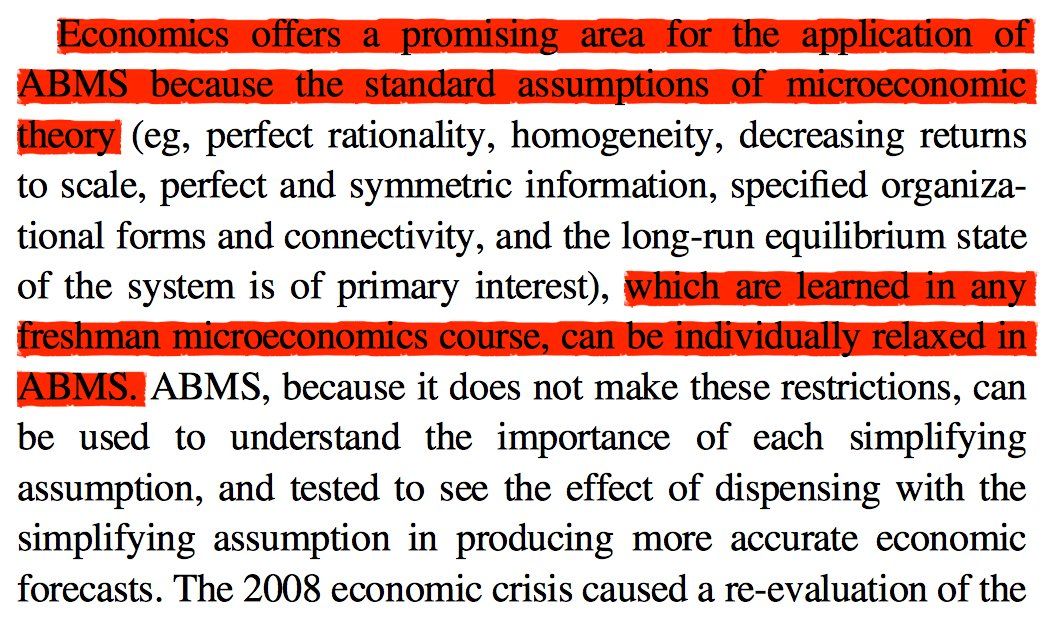
Basically, agent-based models (ABM) offer a cost-effective way to relax major assumptions needed in econ models 3/nPermalink
 Mood 0
-
I think there's no need to "attack" those assumptions per see, but rather to explore their actual span of validity 4/nPermalink
Mood -2 🙁
-
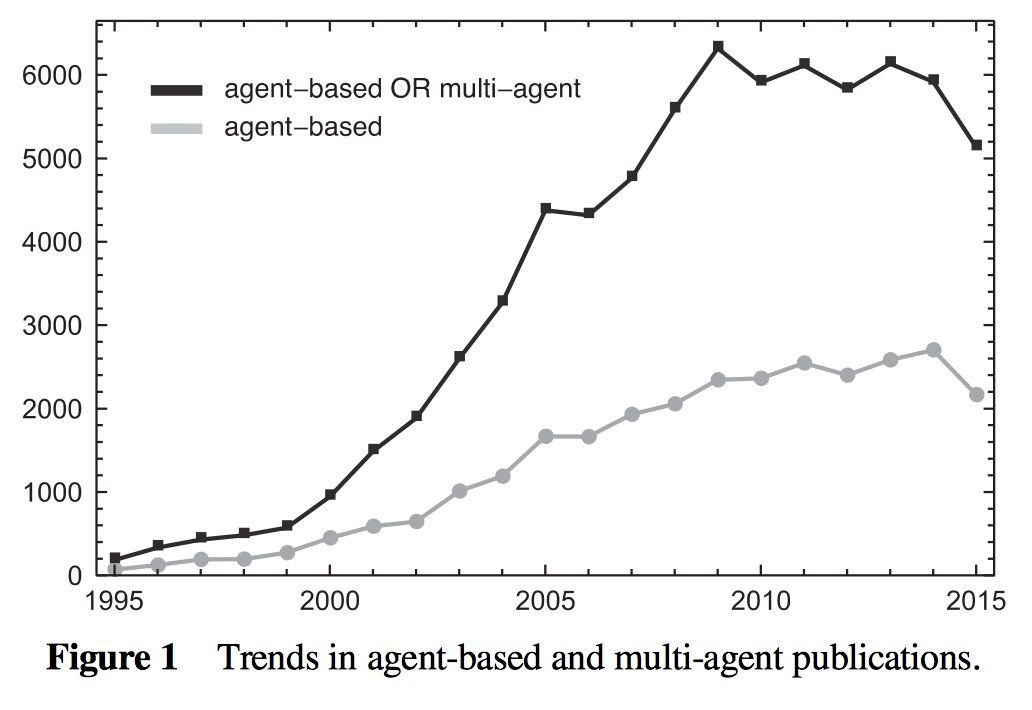
ABM are used in *many* fields. And it's a growing literature, as shown by this graph 5/nPermalink
 Mood +1 🙂
-
(It would be interesting to have similar data but only for economics.) 6/nPermalink
Mood +2 🙂
-
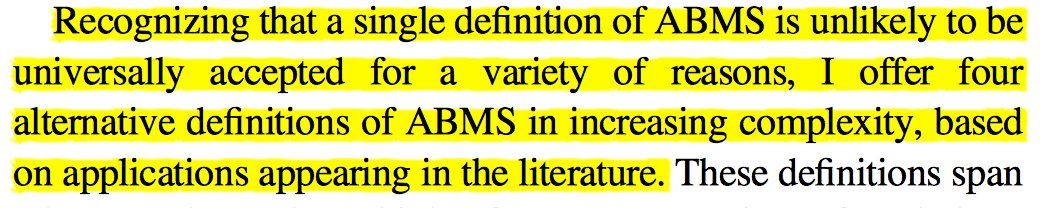
This being said, ABM can sometime refer to *a lot* of *different* things. An effort of definition still need to be done. 7/nPermalink
 Mood 0
-
According to this table, I would say economics will likely use adaptative ABM. At least this is what I think ABM can bring to econ 8/nPermalink
Mood 0
-
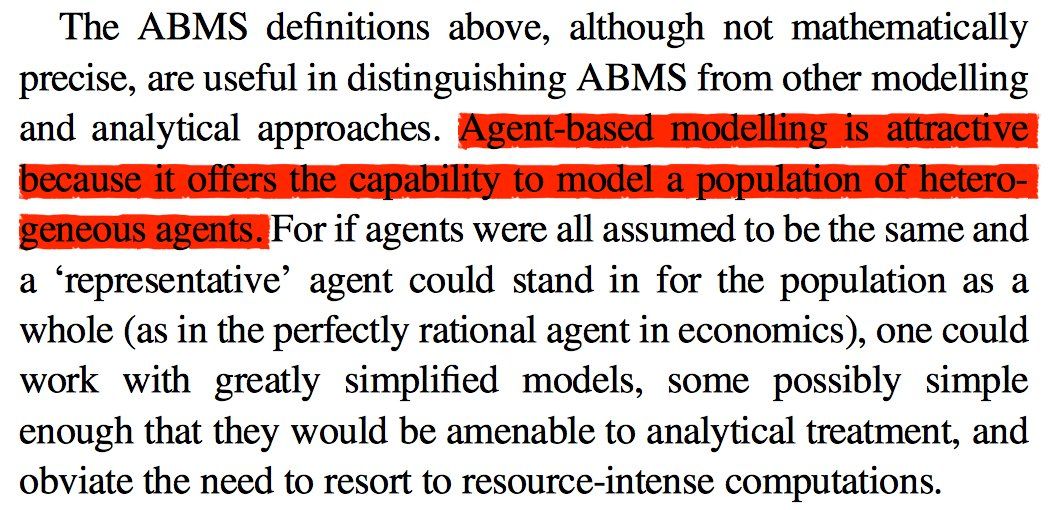
More precisely: it's often quite challenging to model non-trivial heterogeneity in econ models. ABM is very competitive to do this 9/nPermalink
 Mood +2 🙂
-
It's not that heterogeneity is an "extension" of ABM; it's merely a basic feature of this range of model. So the cost-effectiveness 10/nPermalink
Mood 0
-
If one day ABM become a dominant tool in econ, I don't think regular theory will die. On the contrary 11/nPermalink
❤️ 1 Favorite
Mood -3 🙁
-
Econ theory is an amazing tool to model individual behaviour, wether purely individual or in a strategic context 12/nPermalink
Mood +4 🙂
-
I rather see ABM as a complement, in a setting like: microfoundations using regular econ theory, exploration of aggregation with ABM 13/nPermalink
Mood +3 🙂
-
To me, a good ABM in econ is an ABM that is *consistent* with microeconomics. So it *can't* be a replacement of any sort 14/nPermalink
Mood +3 🙂
-
It seems tempting to use ABM for macro related stuff. To be honest, macro can benefit *a lot* from ABM (I'm speaking to you, DSGE) 15/nPermalink
❤️ 1 Favorite
Mood +4 🙂
-
But it can advance micro as well, by modelling organisations, workers-firms interactions, markets, and so on 16/nPermalink
Mood 0
-
I think virtually every aspect of econ can benefit from stronger ABMs 17/nPermalink
Mood +4 🙂
-
Because once again: the goal isn't to "replace" regular econ, the goal is to deepen it and explore previously hard to reach questions 18/nPermalink
Mood 0
-
(Hard to reach because of methodological difficulties) 19/nPermalink
Mood 0
-
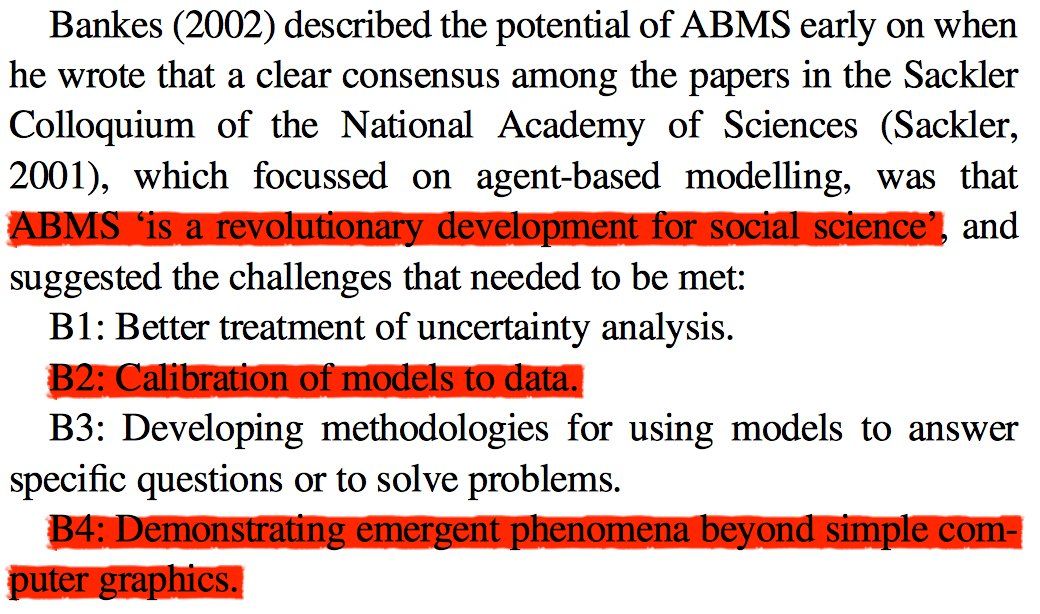
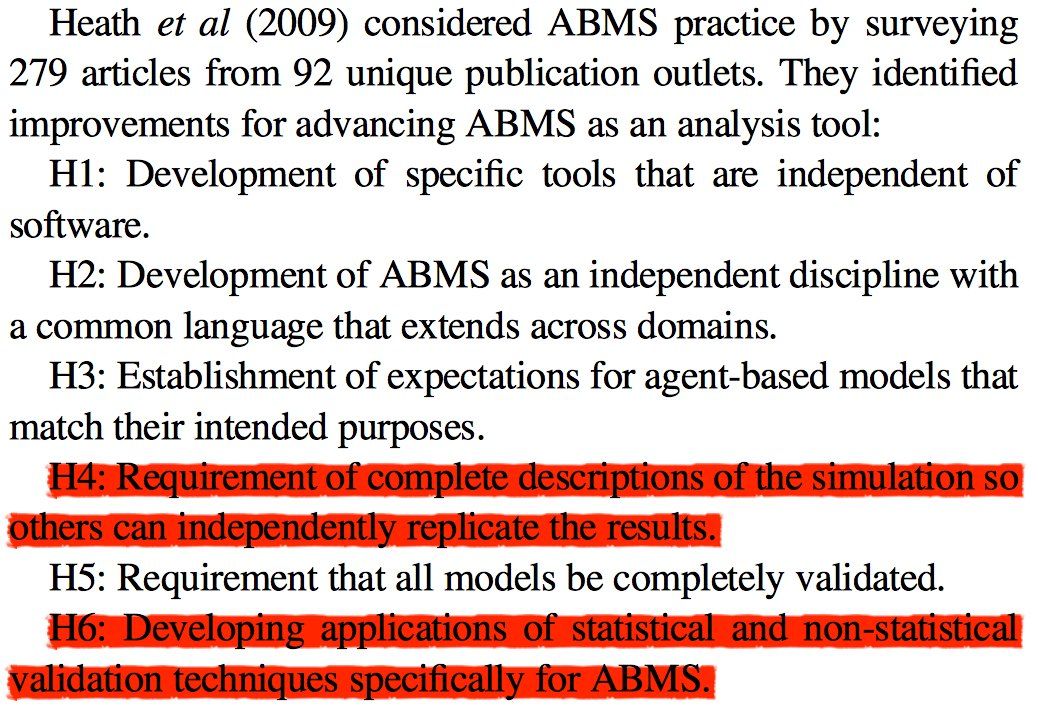
This being said, ABM is still an immature toolkit, despite huge progresses 20/nPermalink
Mood +1 🙂
-
A bunch of (non trivial) issues still need to be addressed 21/nPermalink
 Mood 0
-
I think reproducibility (incl. model description), the relation to data and the statistical exploration of the outputs needs to improv. 22/nPermalink
❤️ 1 Favorite
Mood +1 🙂
-
I would say it now exists fairly easy to use libraries to develop ABM, like Mesa in Python (the one I use): mesa.readthedocs.io/en/master/ 23/nPermalink
Mood +3 🙂
-
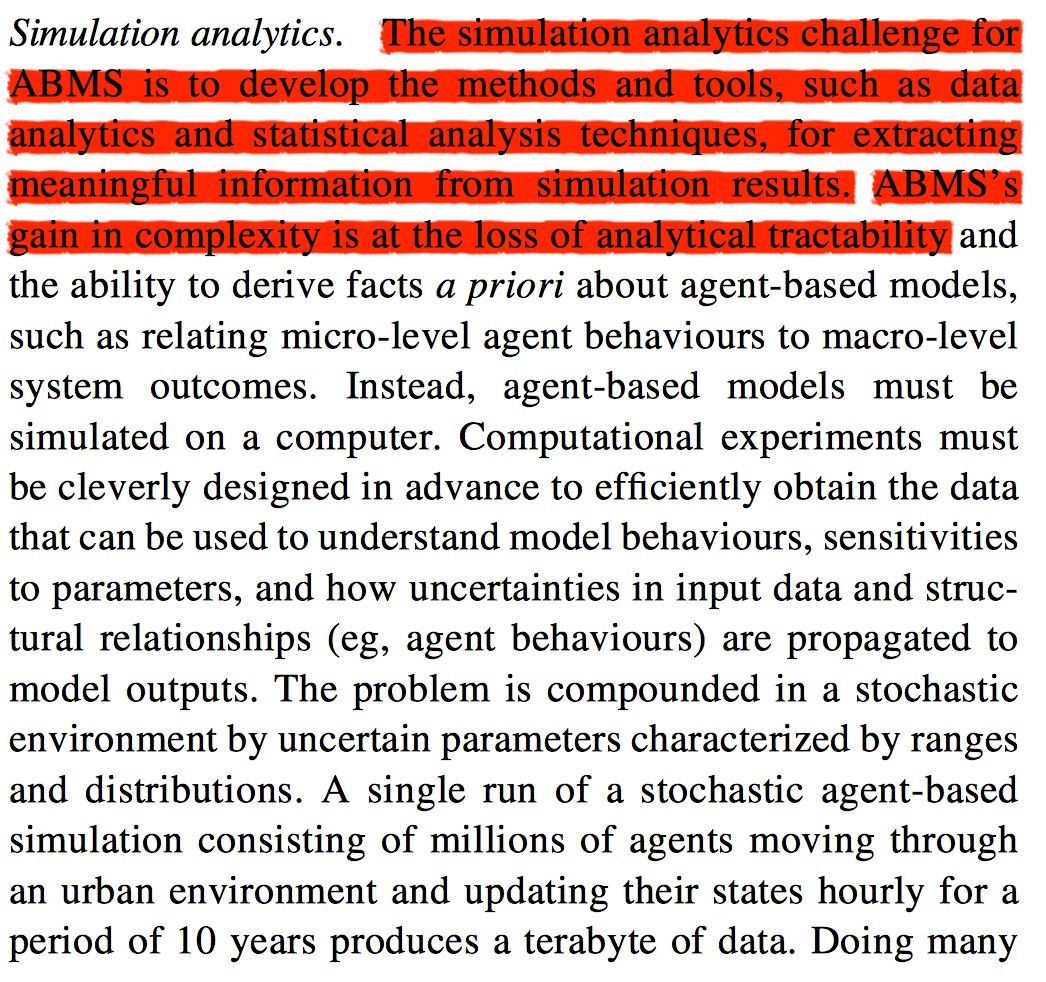
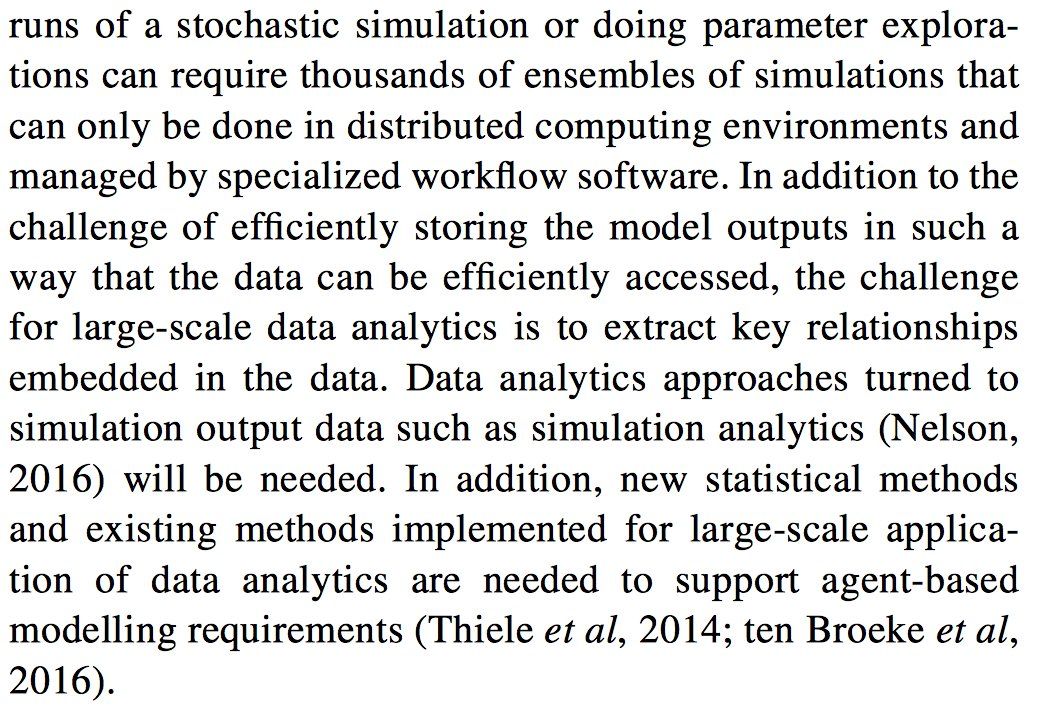
But ABMs produce *a lot* of data. Exploring the output is a real challenge 24/nPermalink
Mood -1 🙁
-
A standard way to assess the sensitivity of the model would also be a huge advancement 25/nPermalink
Mood +1 🙂
-
On this output analysis: 26/nPermalink
 Mood 0
-
Sidenote: ABM can't offer closed forms solutions (they're not tractable). I know it'll challenging for some in econ 27/nPermalink
Mood +1 🙂
-
BUT: closed forms can't be a goal per see. The real question is: is a closed form model inherently better than a untractable one? 28/nPermalink
Mood +2 🙂
-
For me, the answer is NO. Sometime closed-form models are better, sometime ABM are better. So once more: complements, not substitutes 29/nPermalink
Mood +3 🙂
-
I would even go a bit further: rejecting a new tool bc it's not closed-form can't be used as a criterion 30/nPermalink
Mood -1 🙁
-
The goal of econ can't be to only write closed-form models of the world. It's also to explain it 31/nPermalink
Mood 0
-
And if an untractable model can provide better insights compared to a closed-form model, it would foolish to dismiss it 32/nPermalink
Mood 0
-
(In total fairness: using an ABM where a regular model would have been a better tool is also a mistake) 33/nPermalink
Mood +2 🙂
-
(The goal isn't to develop ABM for the sake of developing ABM, the goal is to provide better insights to policymakers, scientists…) 34/nPermalink
Mood +2 🙂
-
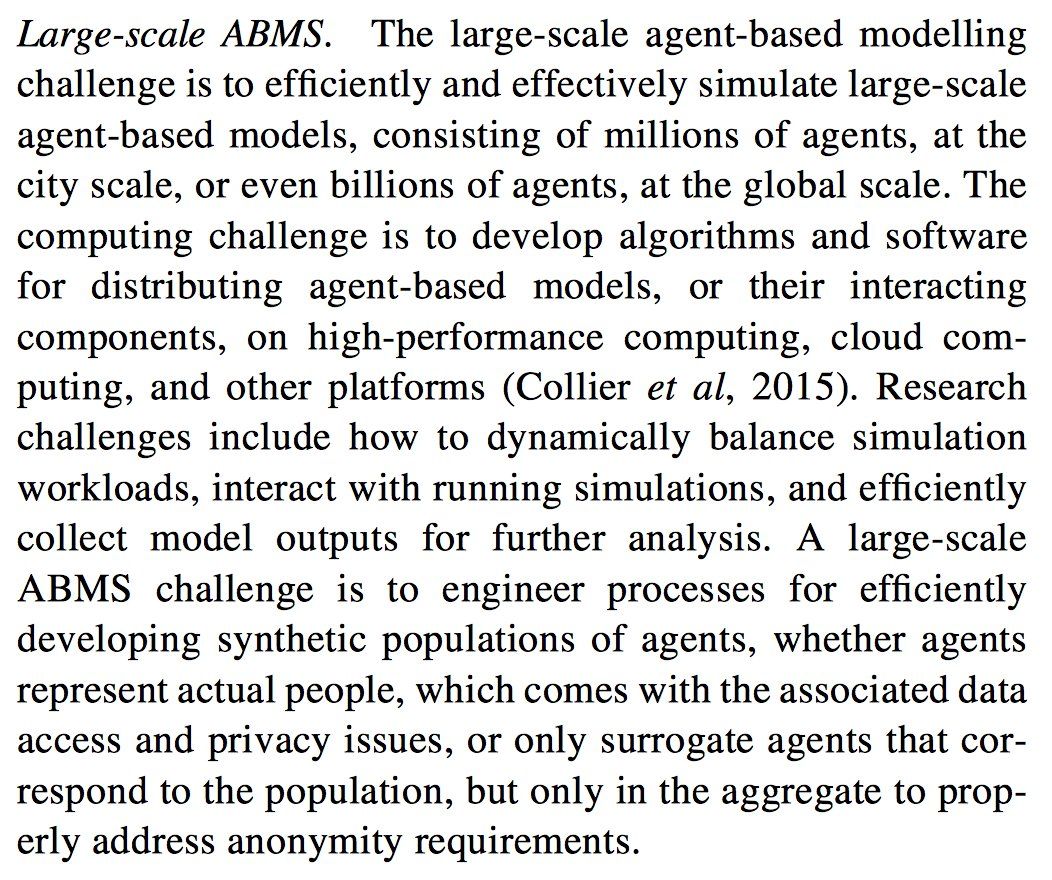
For instance, ABM could be used to simulate a huge number of agents who interact in a non-trivial way 35/nPermalink
 Mood +1 🙂
-
Physics simulate how matter is distributed in the observable universe, so why not something similar with econ? 36/nPermalink
Mood +1 🙂
-
(I'm aware that ABM can drastically change the way we do econ. Less single researchers in their ivory tower, more large-scale collabs) 37/nPermalink
Mood 0
-
(Huge simulations can also cost a lot more to implement, another change for econ that usually doesn't need huge budgets) 38/nPermalink
Mood +2 🙂
-
At the end, ABM are more than a hype. And precisely because they need to improve, we need to dedicate more resources for them 39/nPermalink
 Mood +2 🙂
-
More researchers, more PhDs, more infrastructures… 40/nPermalink
Mood 0
-
At the end, this paper is a worth read. I created a Mendeley group with similar publications: mendeley.com/community/agent-based-models-in-economics-an-introduction/documents/ 41/nPermalink
❤️ 1 Favorite
Mood +2 🙂
-
I hope I ran this tweetstorm not too poorly. Especially, I hope my own thoughts can be distinguished from the paper's author 42/nPermalink
Mood +4 🙂
-
Thanks for reading it, I think more will come in the future! 43/43
Mood +2 🙂