-
.@Apple displayed obvious gender bias while setting the credit limit for a wife and her husband – the husband got 20 times the limit even if his credit score is lower… Everybody involved claimed "it’s the algorithm" A thread ⤵️ bloomberg.com/news/articles/2019-11-09/viral-tweet-about-apple-card-leads-to-probe-into-goldman-sachsPermalink
 ♻️ 2 Retweets
❤️ 4 Favorites
Mood -1 🙁
♻️ 2 Retweets
❤️ 4 Favorites
Mood -1 🙁
-
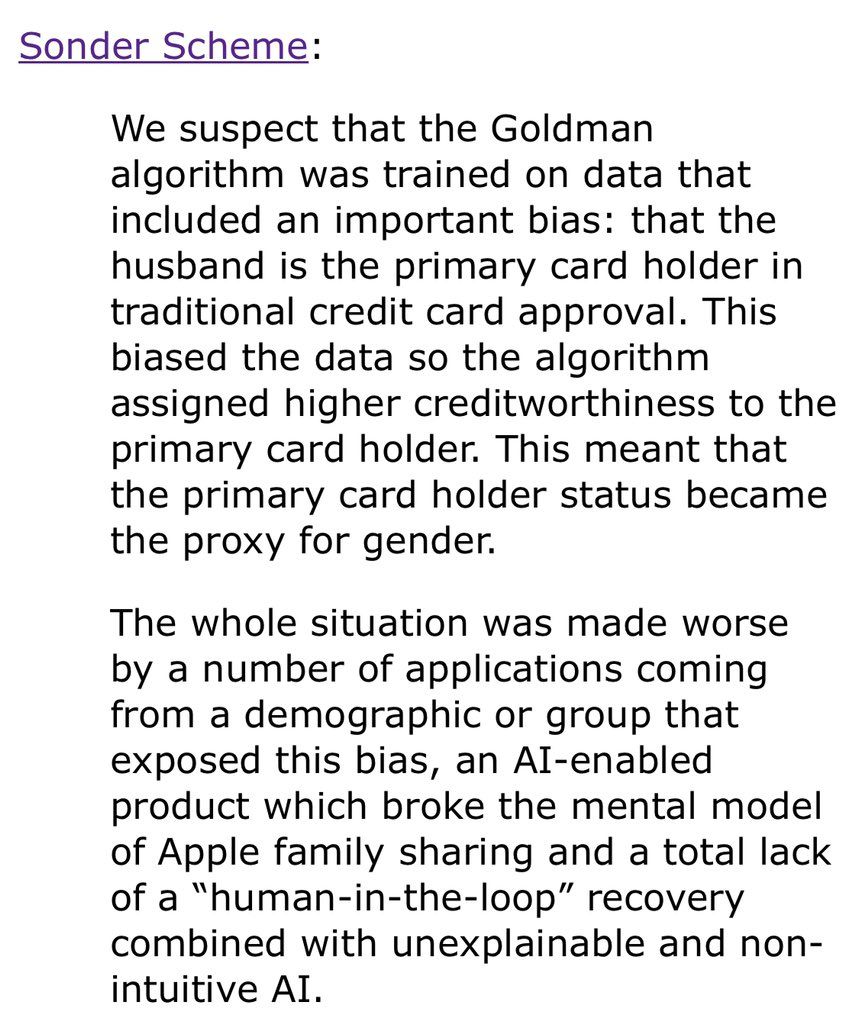
Algorithms are not tractable (too many degrees of freedom) and because of that, it can be challenging to understand *why* it gave a given result (here, why he favored the husband) mjtsai.com/blog/2019/11/15/apple-cards-outsourced-algorithm/Permalink
 ❤️ 1 Favorite
Mood +4 🙂
❤️ 1 Favorite
Mood +4 🙂
-
Scientifically speaking it’s problematic, but the problem also have real societal consequences To me, it pleads in favor of more research into "algorithm accountability": even though algorithms aren’t tractable, how to better understand why they give the results they give?Permalink
❤️ 1 Favorite
Mood +2 🙂
-
Algorithms are also skewed on the data they’re trained on. They replicate bias that exist in the society, for instance in terms of race or gender. One should also be careful about the data used for the training – and I think this is something economists are really good atPermalink
Mood +4 🙂
-
Algorithms are no magic. They are the product of (many) human brains, and there is no reasons why they would be exempt of the many biases our brains have. Being like "just run a ML algorithm on these data" without much thinking is imo reckless and not a good long run strategy…Permalink
Mood 0
-
Also: I’m not saying ML is bad or anything. ML is widely used, ML is skewed in ways we are only starting to discover, and the whole point of this thread is just to say that economists can help improve them Because we have the concepts in our toolbox FIN
♻️ 1 Retweets
Mood +1 🙂